
Are Ottawa Home Prices Falling? Why I Believe More Price Pressure Is Coming
Published: October 16, 2026
By: Dave Robertson, Broker/Team Leader, LIFE Real Estate Group
Reading Time: 5 min read
Key Takeaway: Ottawa’s housing market is showing increasing signs of weakness. While average selling prices have remained relatively stable, rising inventory, slowing sales, and declining benchmark prices suggest that downward pressure on home values could continue. Economic uncertainty, borrowing costs, and affordability challenges are making buyers more cautious.
Ottawa’s Housing Market Is Sending Some Warning Signs
For much of 2026, Ottawa’s real estate market has demonstrated remarkable price stability despite slower sales activity. But beneath those relatively stable average prices, something important has been happening. More homes are coming onto the market than buyers are purchasing, and the gap continues to widen.
As a real estate broker working directly with Ottawa buyers and sellers, I’ve watched this trend develop throughout the year. Properties are facing more competition, buyers have become increasingly selective, and sellers are having to adjust their expectations.
My concern is that we’re beginning to see the effects of this imbalance reflected in home prices. While nobody can predict exactly where the market is heading, I believe the current conditions point toward further downward pressure on Ottawa home values.
Inventory Is Growing Faster Than Buyer Demand
The latest statistics from the Ottawa Real Estate Board provide some compelling evidence.
In September 2026:
- 1,010 homes sold, down 6.6% compared with September 2025.
- 2,927 new listings entered the market, an increase of 38.1% over August.
- 4,813 properties were actively listed, up 7.9% year over year.
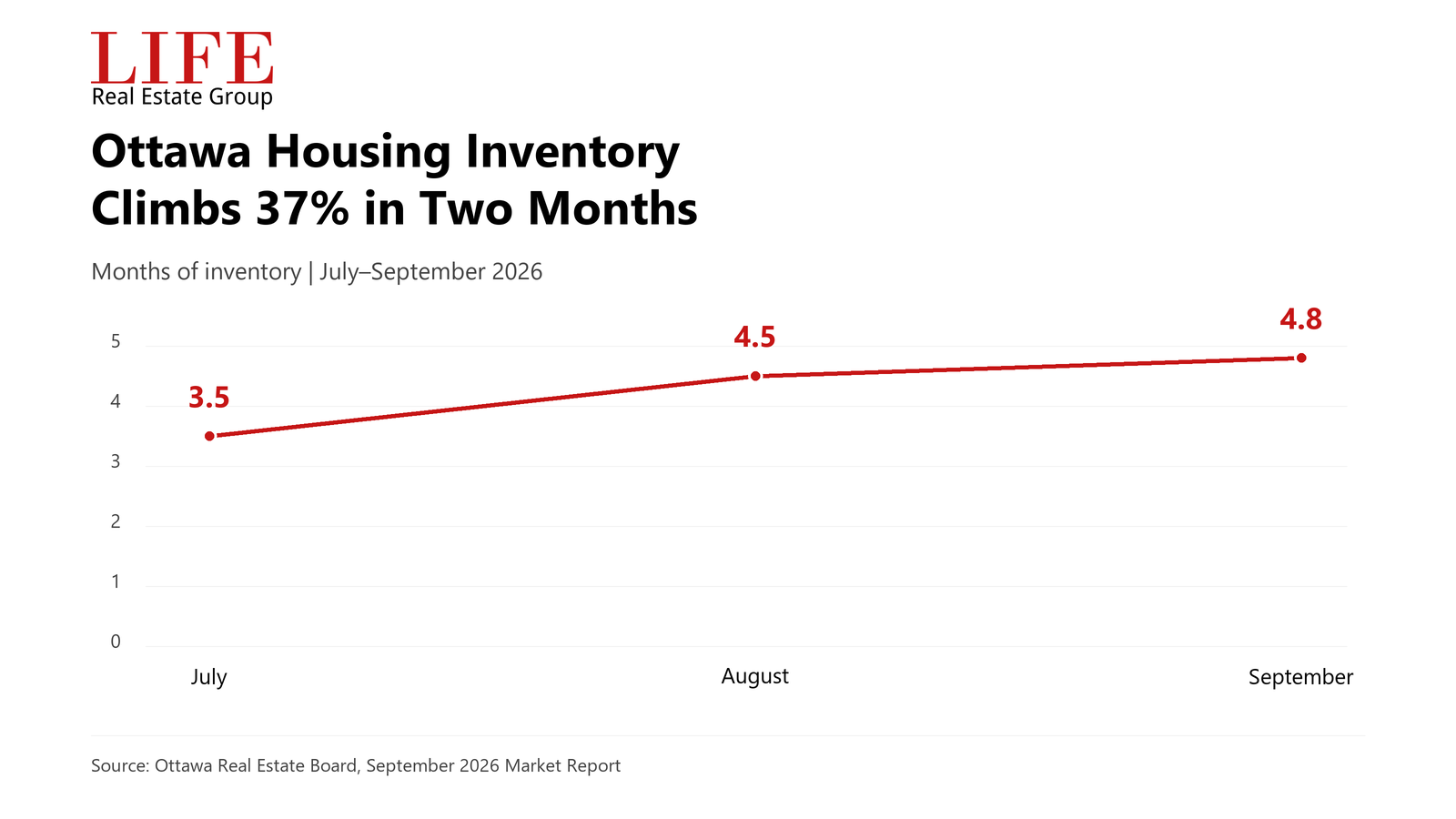
- Months of inventory reached 4.8, compared with just 3.5 in July.
Perhaps the most revealing statistic is the sales-to-new-listings ratio. In July, that ratio was 52.4%. By September, it had fallen to just 34.5%.
In simple terms, approximately one home sold for every three new properties entering the market. That is a significant shift in the balance between supply and demand.
Not every unsold listing remains active, and some seasonal increase in listings is normal. However, September’s increase was substantially greater than the historical seasonal pattern. When inventory accumulates faster than buyers absorb it, sellers face more competition. Unless buyer demand improves or new listings slow considerably, that competition can eventually translate into lower selling prices.
Are Ottawa Home Prices Already Falling?
This is where the statistics become particularly interesting. Ottawa’s average residential sale price in September was $685,640, down just 1.0% from the previous year. On the surface, that suggests a relatively stable market.
But average prices don’t always tell the whole story. The MLS Home Price Index, which measures changes in the value of a representative home while accounting for differences in the types of properties sold, paints a somewhat different picture. Ottawa’s composite benchmark price fell 2.2% between August and September. According to the Ottawa Real Estate Board, this was the largest August-to-September decline recorded since its HPI series began in 2005.
One month doesn’t establish a long-term trend, but combined with rising inventory and weaker sales activity, I believe it’s an important warning sign. There are also substantial differences between property types. In September, the apartment benchmark was down 6.1% year over year, while single-family home values were comparatively stable.
This is why I always caution homeowners against relying exclusively on citywide averages. The market for a detached home in Kanata can behave very differently from the market for a downtown condominium.
Economic Uncertainty Is Keeping Buyers on the Sidelines
I believe the challenges facing Ottawa’s housing market extend well beyond real estate. Canadians are navigating a complicated economic environment, with uncertainty surrounding international trade, geopolitical conflicts, employment, and the cost of living. Trade tensions between Canada and the United States have created concerns about the broader economy. Meanwhile, conflict in the Middle East has contributed to volatility in energy markets and renewed concerns about inflation.
These aren’t simply abstract economic issues. When households feel uncertain about their employment, future income, or monthly expenses, they’re understandably more cautious about making major financial commitments. And buying a home is one of the largest commitments most families will ever make.
The Bank of Canada’s 2026 consumer research reinforces this concern, finding that high prices and economic uncertainty continue to weigh on household spending intentions.
From my perspective, the issue isn’t necessarily that buyers no longer want to purchase homes. It’s that many are less confident about whether now is the right time to make such a significant commitment.
Interest Rates and Affordability Remain Obstacles
Although mortgage rates have come down from their previous highs, borrowing costs remain an important obstacle for many prospective buyers. There’s also an important distinction between the Bank of Canada’s policy interest rate and the rates lenders offer on fixed mortgages. Fixed mortgage rates are heavily influenced by government bond yields, which respond to inflation expectations, financial market conditions, and broader economic developments.
In its September 2026 housing outlook, TD Economics warned that rising bond yields could continue to restrain housing activity. Meanwhile, many households are still dealing with the cumulative effects of years of rising living costs.
Even when inflation slows, everyday expenses don’t necessarily decrease. Groceries, insurance, utilities, property taxes, and other household costs continue to compete for the same dollars buyers need for mortgage payments.
In other words, having more homes available for sale doesn’t automatically mean buyers can afford them.
What I Expect for Ottawa Home Prices
My outlook for the coming months is cautious.
I believe Ottawa home prices are likely to experience continued downward pressure if current inventory and sales trends persist. That doesn’t mean I expect every property to decline in value or that Ottawa is heading toward a dramatic housing crash. Real estate is highly localized. Well-maintained homes in desirable neighbourhoods, particularly those priced appropriately, can still attract strong interest.
However, I expect properties facing significant competition, particularly in segments with elevated inventory, to remain more vulnerable to price reductions. There are also reasons the market could stabilize. New listings typically decline later in the fall, and improved economic confidence or borrowing conditions could bring more buyers back into the market.
The next few months will be important in determining whether the current imbalance is temporary or the beginning of a more sustained adjustment.
What Does This Mean for Buyers and Sellers?
For buyers, the current market offers something that was difficult to find during the pandemic-era housing boom: choice, negotiating flexibility, and time to make informed decisions.
But I wouldn’t recommend trying to predict the exact bottom of the market. Your personal finances, housing needs, and long-term plans remain more important than short-term price movements.
For sellers, I believe the message is increasingly clear: pricing and presentation matter more than ever.
When buyers have several comparable properties to choose from, an overpriced listing can quickly lose momentum.
Sellers need to understand not only what similar homes sold for several months ago, but also which properties they’re competing against today, how quickly homes are selling, and whether local inventory is growing.
The longer a property remains on the market without attracting serious interest, the greater the risk that changing market conditions will work against the seller.
Final Thoughts
Ottawa’s housing market isn’t collapsing, but I don’t believe we should overlook the warning signs. Rising inventory, weaker absorption, declining benchmark prices, and persistent economic uncertainty are creating conditions that increasingly favour buyers. My expectation is that prices will remain under pressure until we see a meaningful improvement in buyer demand or a reduction in the number of homes competing for those buyers.
For homeowners considering a move, understanding what’s happening in your specific neighbourhood and price range has never been more important.
At LIFE Real Estate Group, we provide detailed, neighbourhood-specific market analyses that go beyond citywide averages to help homeowners make informed real estate decisions.
If you’re considering buying or selling, or simply wondering how current market conditions are affecting your home’s value, we’d be happy to help.
Sources: Ottawa Real Estate Board, September 2026 Market Report (published October 5, 2026); Bank of Canada, Canadian Survey of Consumer Expectations and Business Outlook Survey, Q2 2026; TD Economics, Provincial Resale Market Outlook, September 29, 2026; CMHC, Housing Market Outlook 2026.
About The Author